
Local Legends
Approaching myth and material at the Sea Ranch
01.31.2026
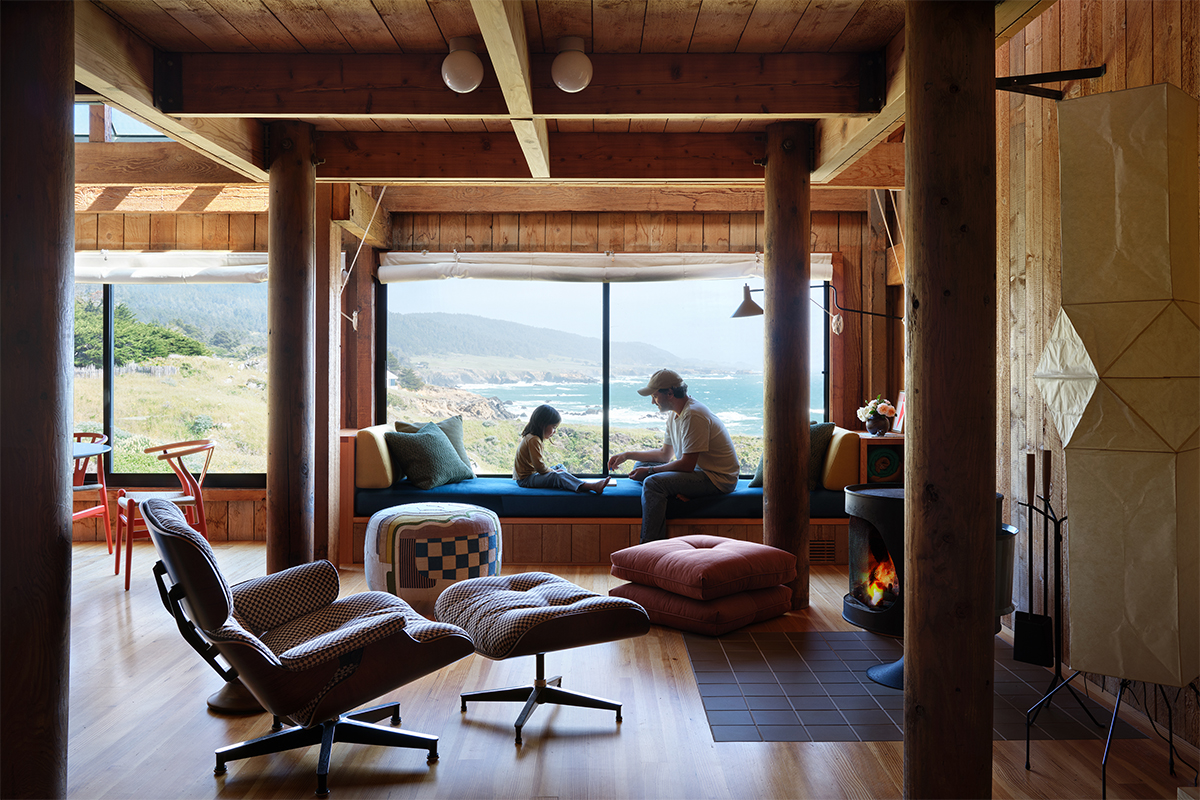
They say you should never meet your heroes. The implication is that proximity breeds disappointment, that myth collapses under scrutiny. The Sea Ranch tests this theory. For generations of architects and designers, the Sea Ranch condominiums have occupied an almost unreal space in the collective imagination, becoming a pilgrimage site for many. Perched on a rocky outcropping along one of Northern California’s most dramatic stretches of coastline, their jagged redwood forms offer a structurally expressive, vernacular alternative to the international style that dominated 1960s architecture. It is an architecture so deeply rooted in place that it feels inevitable—a synthesis of land, climate, material, and ideology.
For most of its existence, the 5,000 acres that now comprise the Sea Ranch were completely forested with old stands of redwoods, Bishop pine, and fir. By the end of the nineteenth century, these forests had been logged to supply San Francisco. The cove where Condominium One now sits, known as Black Point, was a nexus of forest and sea: loggers dragged timber down to the ocean to be loaded onto steamers, forming a bustling outpost of chutes, barns, and clapboard cabins. Architect William Turnbull Jr. identified these early structures as the logical DNA for the development’s vernacular forms.
Given this history, Turnbull’s choice to render all of Sea Ranch’s structures in redwood was more than a material decision—it philosophically tied the buildings to the land. In Trees in Paradise, historian Jared Farmer describes how certain trees in California accrued meaning far beyond their ecological role. Of these, the coastal redwood emerged as the great northern myth: ancient, monumental, native, and seemingly eternal. While non-native palms and citrus were planted elsewhere to manufacture paradise, redwoods stood as proof of an existing one. By the mid-twentieth century, redwood had become a material thick with meaning. It served as shorthand for a bohemian Northern Californian identity defined less by mastering nature than by living in harmony with it.
Through this lens, redwood’s role at Sea Ranch reads as a deliberate alignment with utopian ideals. Turnbull, alongside his partners at MLTW and landscape designer Lawrence Halprin, sought to give shape to a new way of life—a community living in dialogue with its environment. Redwood provided a material vocabulary suited to that ambition, offering shelter without the monumentality of concrete and structure without the spectacle of steel and glass. At Sea Ranch, the buildings cast off the universalizing impulses of the international style to imagine a modernism informed by context.
When our clients asked us to shape the next chapter of their adjacent Sea Ranch units, we felt the weight of the project’s mythology. Conceived as fraternal twins, the two units had diverged over time. One remained largely untouched, its unvarnished wood aged by sun and salt air. The other bore the marks of a misguided 1990s renovation that obscured much of the original intent. In collaboration with our clients and Turnbull Griffin Haesloop Architects, successors to William Turnbull, we set out to remediate what had been lost while creating a space that supported connection to family and the surrounding landscape.
The work became an exercise in architectural forensics. We spent time in archives, studied original drawings, and made repeated visits to Charles Moore’s unit at Condominium One. What emerged was a more complicated picture than the place’s mythology suggests. The construction is improvisational. Boards and framing were cut with chainsaws. Douglas fir slabs, likely sourced pragmatically from local hardware stores, comingle with the redwood. This was not precious architecture. It was adaptive, economical, and unabashedly scrappy. These realities tend to disappear in museum exhibitions and coffee table books, but they are essential to understanding the ethos of the place.
This discovery felt both clarifying and liberating. To renovate Sea Ranch in good faith would require a certain looseness. The original designers were not pursuing reverence; they were responding to circumstance and inventing along the way. That sensibility became our guide.
The range of grain patterns, patinas, and saw textures in the existing interiors shaped our material palette and pushed us to be inventive in how we treated each board. Redwood was never a single finish, but a spectrum of textures and tones. We selectively introduced old-growth redwood reclaimed from barns near Yosemite, the baroque grain patterns of the logs adding visual interest and depth. Elsewhere, where uniformity and utility were paramount, such as the kitchen millwork, Douglas fir offered a quieter counterpoint. The smallest details became opportunities for specificity: the spherical cabinet door pulls throughout the project were turned on a lathe, with the wood carefully oriented to create concentric circle patterns that celebrate the grain. With these details, the renovation elevated the project by elaborating on the possibilities already present in the wood.
Charles Moore’s unit offered an unexpected kind of permission to play. Moore was both a founding member of MLTW and a longtime Sea Ranch resident, and his condominium reveals decades of experimentation layered atop the original framework. His MLTW partner Donlyn Lyndon remarked, “Charles was continuously reimagining the unit: adding objects and furniture that took his ever-active fancy, painting and repainting its ‘finished’ surfaces, and filling it with his wit and companionship.” His work makes a persuasive argument that wood, while essential, is not sacred. When redwood covers every surface, it can obscure the legibility of form and compete with the very architectural moves it is meant to articulate.
This insight shaped our most challenging decision: painting the wood. Wood is central to our design practice. We are drawn to its tactility, warmth, and ability to ground a space emotionally and materially. Painting old-growth redwood feels radical because it is, in practice, irreversible. Even if stripped, the patina accrued over decades disappears, along with saw marks and textural nuances, leaving the wood essentially newly milled. There was real hesitation. Over time, through research and observation, we came to see paint not as a way to erase materiality, but as a tool for clarifying it.
Determining where paint should begin and end felt perilous. Our team compared the process to pulling a loose thread on a sweater. The guiding principle was to restore clarity to internal forms that had been visually lost within the redwood’s relentless presence. Turnbull’s writings reveal his intent to preserve barn-like interiors without subdividing spaces, using towers he likened to “super-scaled furniture” to define zones. He described the sleeping loft as “a four-poster bed, itself a story high, and sheltering underneath its legs a dark cozy fireplace area,” and the kitchen and bath as “a two-story cabinet… a functional bureau.” He reserved smoother, milled boards for these furniture towers to distinguish them from the rougher architecture. Moore found this distinction too subtle in his own unit, experimenting with paint and color blocking to further articulate the forms. We followed his lead.
The colors themselves were drawn from Lawrence Halprin’s original Sea Ranch landscape plans, embedding the palette directly into the project’s DNA. Our sampling process was exhaustive, testing paint on rough-sawn and smooth boards, varied grain patterns, and different sides of the same piece of wood. What emerged was striking. The wood transformed the paint. Color never simply sat on the surface; it was absorbed, softened, and altered by the material beneath. The boards became both canvas and collaborator. This remained a wood interior through and through, paint and all.
In working so closely with the material, we were reminded that Sea Ranch’s richness lies in its engagement with the physical world. For so long, we admired the building for the ideas it represented. But buildings are not ideas. They are made by people, under constraints, over time. It is in these moments of compromise and adaptation, where mythology gives way to material reality, that the Sea Ranch becomes most compelling. Its idealism was never about perfection, and that is why it endures. The wood continues its work—weathering, connecting, sheltering. It grounds the architecture both physically and philosophically, giving way to a form rooted not in abstraction but in soil, fog, and cliffside wind.
Text by Ashley Takacs
Photographs by Stephen Kent Johnson
Farmer, Jared. Trees in Paradise: A California History. W. W. Norton & Company, 2013.
MLTW – The Sea Ranch, California 1963-. Residential Masterpieces 29. Edited by ADA Editors, Ada Edita Global Architecture, 2019.
Fletcher, Jennifer Dunlop, and Joseph Becker, editors. The Sea Ranch: Architecture, Environment, and Idealism. Prestel, 2018.


